A four-lobed cross-section that seals on two contact points per side instead of one — lower friction, no spiral failure, and often no back-up ring needed. Select a size below and send it straight to our sales engineers.
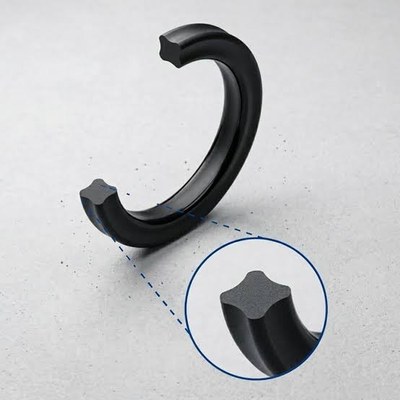
An X-Ring — also sold as a Quad-Ring — replaces the O-ring's single round cross-section with a four-lobed profile, so each side of the gland contacts the seal at two points instead of one. That geometry is what gives X-Rings their two headline advantages over O-rings in dynamic service: lower running friction (each lobe carries less load than a single round bead under the same squeeze) and resistance to spiral failure, the twisting/rolling breakdown that affects O-rings on long-stroke reciprocating seals.
The trade-off is tooling cost and lead time — X-Ring molds are more complex than O-ring molds, so they carry a price premium and are typically specified only where the dynamic-service benefit justifies it.
| Dimension | What it is |
|---|---|
| ID (Inside Diameter) | Same measurement method as an O-ring — across the inner opening, through the centre |
| W (Width / Cross-Section) | The lobed profile's overall width, measured the same way as O-ring CS — some catalogs label this "W" rather than "CS" to flag the different profile |
| OD (Outside Diameter) | OD = ID + (2 × W), same formula as a standard O-ring |
X-Rings follow their own dedicated size series (X0004–X0475) rather than the AS568 O-Ring dash numbers — FITCO's selector below uses the X-Ring-specific cross-section and ID table directly, so the dash number you get matches an X-Ring size chart, not an O-Ring one.
X-Rings (Quad-Rings) follow their own dedicated X-series size chart, similar in structure to AS568 but with distinct dash numbers. Confirm groove depth separately — X-ring glands are not interchangeable with O-ring glands.
Two sealing surfaces per side spread contact pressure, cutting running friction versus a round O-ring under the same squeeze.
The lobed profile resists the twisting/rolling that causes spiral failure in O-rings under long-stroke reciprocating service.
If one lobe is nicked or worn, the second sealing surface on that side still seals — a built-in backup an O-ring doesn't have.
X-Rings use the same cross-section bands as AS568 O-rings (1.78 / 2.62 / 3.53 / 5.33 / 6.99mm) but their own X-series dash numbers, and are not dimensionally interchangeable in the groove — gland depth and width differ. Always specify "X-Ring" or "Quad-Ring" explicitly on your drawing.
General-purpose seal for mineral oils, fuels and hydraulic fluids.
Material detail →-20°C to +200°CHigh-temperature, chemical-resistant sealing for oil & gas and process industries.
Material detail →-15°C to +327°CNear-universal chemical resistance for the most demanding process seals.
Material detail →-40°C to +150°CWater, steam and weather-resistant sealing — the wrong choice for mineral oil.
Material detail →-30°C to +150°CHigher heat and abrasion resistance than standard NBR for demanding drives.
Material detail →-60°C to +230°CFood-, medical- and electrically-safe sealing across a wide temperature band.
Material detail →-60°C to +200°CSilicone's temperature range with added fuel and oil resistance standard silicone doesn't have.
Material detail →-10°C to +230°CExtreme chemical + heat resistance for sour gas and amine service beyond standard FKM.
Material detail →-20°C to +200°CGeneral-purpose FKM dipolymer, 66% fluorine — the baseline Viton grade for standard petroleum and fuel contact.
Material detail →-20°C to +200°CTerpolymer with ~68% fluorine — enhanced resistance to inorganic acids, caustics and harsh industrial fluids.
Material detail →-15°C to +200°CHigh-fluorine terpolymer (~70%) engineered for oxygenated automotive fuels and alternative fuel blends.
Material detail →-40°C to +200°CLow-temperature specialist grades — cold flexibility down to -40°C without giving up FKM's fluid resistance.
Material detail →-20°C to +200°CHigh-hardness FKM engineered to prevent Anti-Explosive/Rapid Gas Decompression failures in high-pressure systems.
Material detail →-20°C to +230°CThe core Viton Extreme terpolymer — amine and high-pH chemical resistance beyond standard FKM.
Material detail →-20°C to +230°CPeroxide-cured Viton Extreme with added steam and acid resistance.
Material detail →-20°C to +230°CThe broadest base-resistance Viton Extreme formulation, for multi-chemical process exposure.
Material detail →-40°C to +120°CGeneral-purpose weather- and ozone-resistant rubber with moderate oil resistance.
Material detail →X-Rings share the same cross-section bands as AS568 O-rings but follow their own X-series dash numbers (X0004–X0475) — they are not gland-interchangeable. Groove depth and width differ between the two profiles.
Choose an X-Ring for dynamic, reciprocating seals where friction or spiral failure is a known problem — the four-lobed profile spreads contact pressure and resists the twisting that causes O-ring spiral failure.
Yes — the four-lobed mold is more complex to tool than a round O-ring mold, so X-Rings carry a price premium. They're typically specified only where the dynamic-service benefit justifies the extra cost.