When system pressure pushes an O-ring into the gland clearance gap, a PTFE back-up ring closes that gap and stops extrusion damage. Sized to match your O-ring's dash number and cross-section.
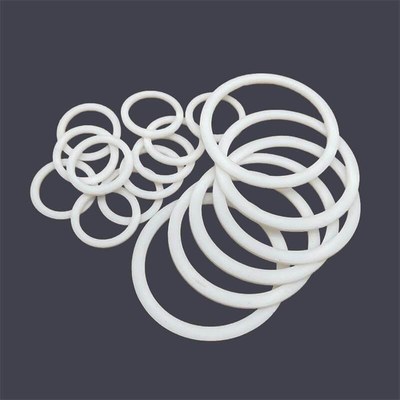
An O-ring seals by elastic deformation, but that same elasticity is its weak point under pressure: above a threshold that depends on gland clearance, hardness and pressure, the O-ring extrudes — gets pushed into the gap between mating parts — and nibbles or tears at the low-pressure edge. A back-up ring is a rigid, low-friction PTFE ring installed adjacent to the O-ring, on the side of the extrusion gap, that physically blocks the O-ring from reaching the clearance gap.
Back-up rings don't seal on their own — they're a mechanical support component, always paired with an elastomer O-ring or X-ring. FITCO cuts and molds them to match the same dash-number families as our O-ring range, so the pairing is a direct lookup rather than a custom fit exercise.
| Grade | Best For |
|---|---|
| Virgin PTFE | General-purpose, widest chemical compatibility, lowest cost |
| Glass-Filled PTFE (15–25%) | Higher pressure and extrusion resistance, moderate wear duty |
| Bronze-Filled PTFE | Highest load-bearing capacity, best thermal conductivity — avoid in corrosive/acidic media |
| Carbon-Filled PTFE | Wear and extrusion resistance with better chemical resistance than bronze-filled |
Back-up rings follow their own dedicated size series (R0004–R0475), separate from the O-ring's AS568 dash number, with width (W), thickness (T), lead-in (A) and corner radius (R) construction set by the cross-section band. Use the configurator below to find the back-up ring size matching your O-ring's ID.
Construction dimensions (W/T/A/R) are set by the cross-section band, not the individual dash number — confirm your exact gland drawing before finalizing.
One back-up ring placed on the low-pressure side of the O-ring, opposite the extrusion gap.
Two back-up rings, one on each side of the O-ring, for systems where pressure direction reverses.
Split (scarf-cut) rings for glands that can't accept a solid ring during assembly — specify in your enquiry.
No — most static and low-pressure seals don't need one. Back-up rings become necessary as system pressure, gland clearance, or temperature rise to the point where the O-ring risks extruding into the clearance gap.
FITCO back-up rings follow their own dedicated size series (R0004–R0475), separate from the O-ring's AS568 dash number — match by inside diameter (ID) to find the corresponding back-up ring size.
Virgin PTFE covers most general-purpose needs. Move to glass-filled for higher pressure, bronze-filled for maximum load-bearing (avoiding corrosive media), or carbon-filled for wear resistance with better chemical compatibility than bronze.